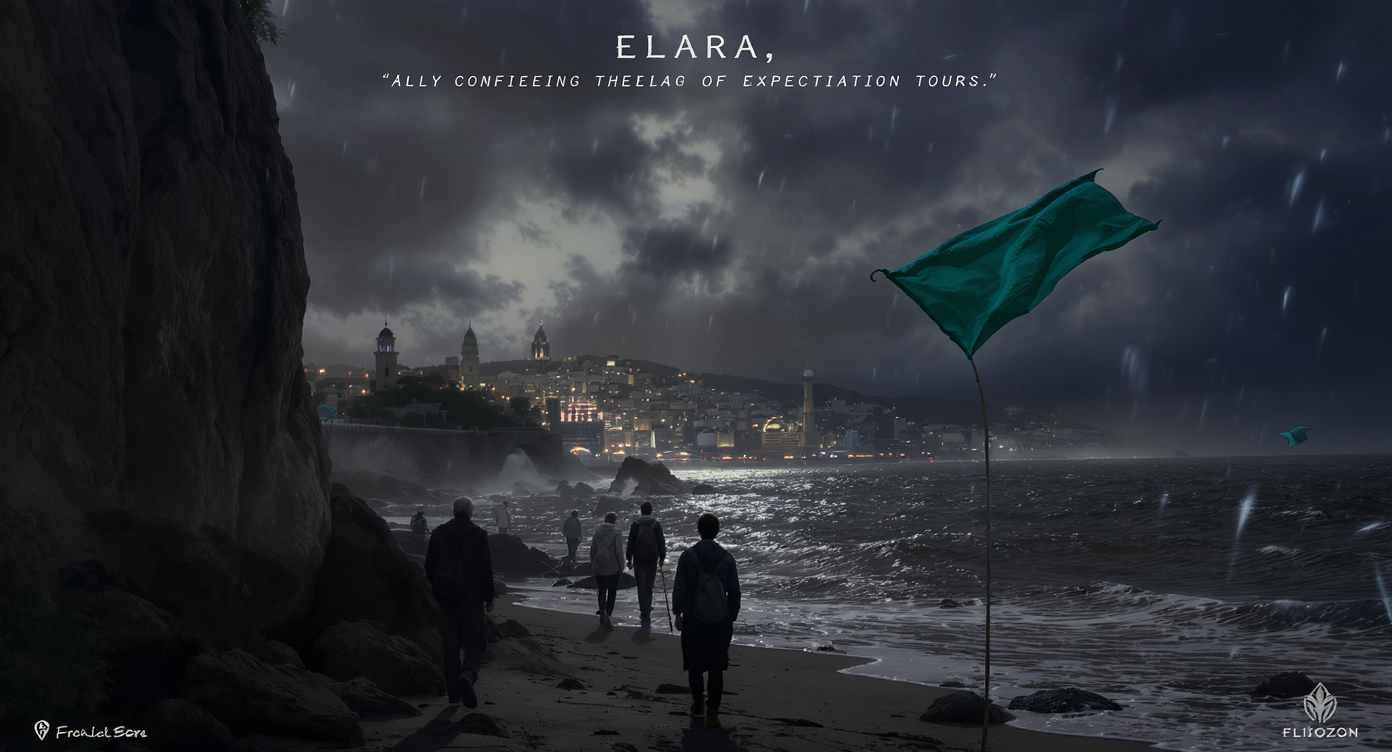
The Uncharted Current
Elara, a dreamer from a quiet coastal town, yearns for a life beyond its predictable shores. Through a series of formative friendships, heartbreaks, and the bewildering vastness of city life, she navigates the tumultuous transition from naive observer to a woman charting her own unique course. This is a story of discovering self amid the shifting tides of expectation and experience.

The Uncharted Current
The Uncharted Current
Elara was a creature of the tideline, a silent observer perched on barnacle-encrusted rocks, watching the sea surrender its secrets with each receding wave. Her childhood unfolded in a small, windswept town called Oakhaven, where the lighthouse was the tallest structure and the rhythm of life was dictated by fishing boats and tourist seasons. She saw the world in intricate detail: the delicate veins of a seaweed frond, the determined scuttle of a crab, the way the light splintered on the water's surface. But as she grew, the tideline began to feel less like a wonderland and more like a boundary.
Adolescence arrived like an unexpected storm, churning the calm waters of her youth. The town, once a comforting embrace, now felt like a suffocating cage. The predictable lives of the adults around her—the fishmonger, the librarian, the lighthouse keeper, eternally polishing his lens—filled her with a quiet dread. Was this all there was? Her salvation arrived in the form of Maya, an older girl with hair the color of sea salt and eyes that held the untamed glint of distant horizons. Maya spoke of cities humming with electric energy, of art that screamed and music that soared, of lives lived without anchors. She was a revelation, a whispered promise of escape. Elara clung to Maya's stories, to the belief that somewhere, there was a vast, exciting other place.
Then, as suddenly as she appeared, Maya vanished. A terse note, a rumor of a bus ticket to a distant city, and then silence. Elara felt a profound sense of abandonment, a void where her carefully constructed dreams of escape had been. Maya hadn’t just left; she’d taken the map with her. The familiar comfort of Oakhaven now felt like a betrayal, its quiet beauty masking a deeper emptiness. It was this heartbreak, this raw yearning for a life unlived, that finally propelled Elara to act. She applied to universities far from the coast, choosing a bustling metropolis she’d only seen in photographs, a place Maya would have loved.
Stepping into the city was like plunging into an ocean of noise and anonymity. The air thrummed with a frantic energy, and buildings soared like impossible cliffs. Initially, it was exhilarating. She felt a thrilling sense of liberation, a detachment from the 'smallness' of Oakhaven. But the city's vastness also brought a new kind of isolation. University life was a confusing maze of superficial connections, competitive anxieties, and endless choices. Everyone seemed to have a curated persona, a perfectly packaged ambition. Elara, still a quiet observer, found herself struggling to find her authentic voice amidst the clamor. She drifted through classes, tried on different identities like ill-fitting clothes, and felt a familiar disillusionment creeping in. The other place wasn't the simple answer she’d hoped for; it was just a bigger, more complicated question.
One rainy afternoon, seeking refuge in a dusty old bookstore, Elara stumbled upon a collection of essays by an obscure philosopher. His words resonated with her unspoken anxieties, speaking of the inherent human struggle to define oneself against the backdrop of a meaningless universe. It wasn't an easy read, but it sparked something. Later that week, during a moment of profound loneliness in a sprawling city park, she found herself talking to an old man bundled in a thick coat, feeding pigeons. He had eyes that held the same deep knowing she'd seen in the eyes of old fishermen. He spoke of his life as a former lighthouse keeper on a remote island, of watching ships navigate treacherous currents, and of how the most profound journeys were often the ones taken within. He told her, "The sea doesn't care if you know where you're going, only that you know how to read its currents." His words were a quiet echo of her childhood, a forgotten wisdom rising from the depths.
The encounter was a subtle turning point. Elara began to shed the expectations she’d carried, both her own and those she perceived from others. She stopped trying to fit into a mold and started listening to her own internal current. She found solace not in grand ambitions, but in smaller, more meaningful pursuits. She volunteered at a community garden, started writing short stories about the city's forgotten corners, and reconnected with the simple act of observing. She learned that the purpose of the lighthouse wasn't to tell the ship where to go, but to show it where the dangers lay, to help it find its own path.
Years passed. Elara, now in her late twenties, was not a famous artist, nor a high-flying executive. She was a content writer for a small publishing house, her words helping others tell their stories. She had built a life filled with genuine connections, with friends who saw her, not just a version of her. Her apartment, filled with books and plants, felt like a harbor. She still visited Oakhaven sometimes, walking the familiar tideline, the lighthouse a constant against the horizon. The town no longer felt small; it felt like her foundation. The vast world of the city no longer felt overwhelming; it felt like a canvas. She had learned to read her own currents, to navigate the uncharted waters of her own life, not by finding a destination, but by embracing the beautiful, unpredictable journey itself. The girl who once watched the waves for answers had finally understood that the answers were always within the ebb and flow of her own evolving self.